AGPL-3.0 · free, no paid tier · v0.9.0 beta

Run your Hytale server from a browser.

TalePanel is a free, open-source control panel for Hytale servers. You install it on your own machine, open it in a browser, and it becomes the place where you start and stop your server, watch the console, upload and disable mods, switch worlds, ban a griefer, take a backup and hand your staff their own logins — without ever opening a terminal again.

It's what Pterodactyl is for Minecraft — except it actually understands Hytale: worlds, mods, plugins and players are real objects with their own screens, not files you SSH into. And when one machine stops being enough, you add a second one and move servers between them, using the same panel.

root@vps — fresh Debian / Ubuntu
sudo bash <(curl -fsSL https://raw.githubusercontent.com/BitaceS/talepanel/main/scripts/install.sh)

One command on a fresh VPS. The script installs Docker and the stack for you, provisions a real Let's Encrypt certificate and creates your owner account — you never write a compose file. No domain? It derives an sslip.io hostname from the public IP and still gets a valid certificate. Modes: panel, daemon, both, upgrade, uninstall, check. Read it before you pipe it into a shell — that is the point of it being on GitHub.

Never rented a server before, and none of the words above mean anything to you? Start here instead — the same thing, explained without the jargon.

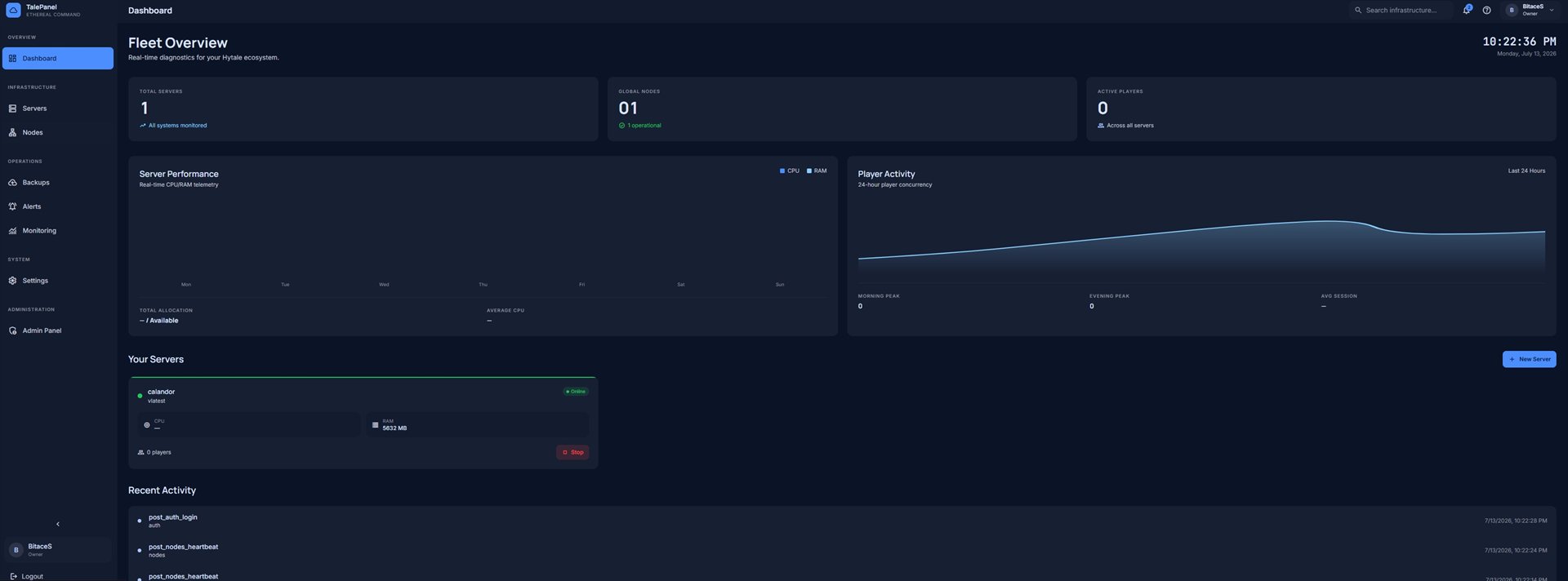
TalePanel fleet overview: total servers, nodes, active players, CPU and RAM telemetry, server list and recent audit activity
A live instance. One node, one Hytale server, real telemetry from the daemon.
What is actually different

Three things the alternatives don't do.

A cluster, not a server list

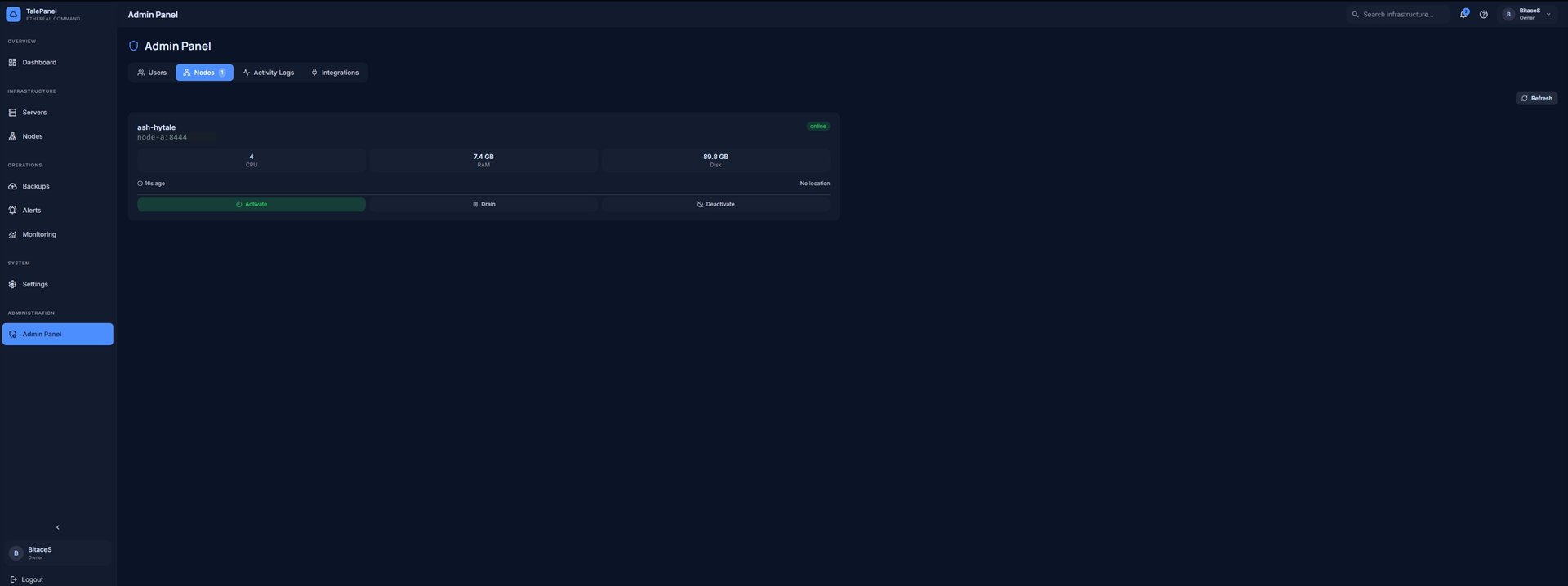
A Go control plane plus a separate Rust daemon per node. You add a node by running the installer on it with a single-use enrollment token; the node registers itself and heartbeats back. You get per-node CPU, RAM, disk and network metrics and aggregated cluster stats.

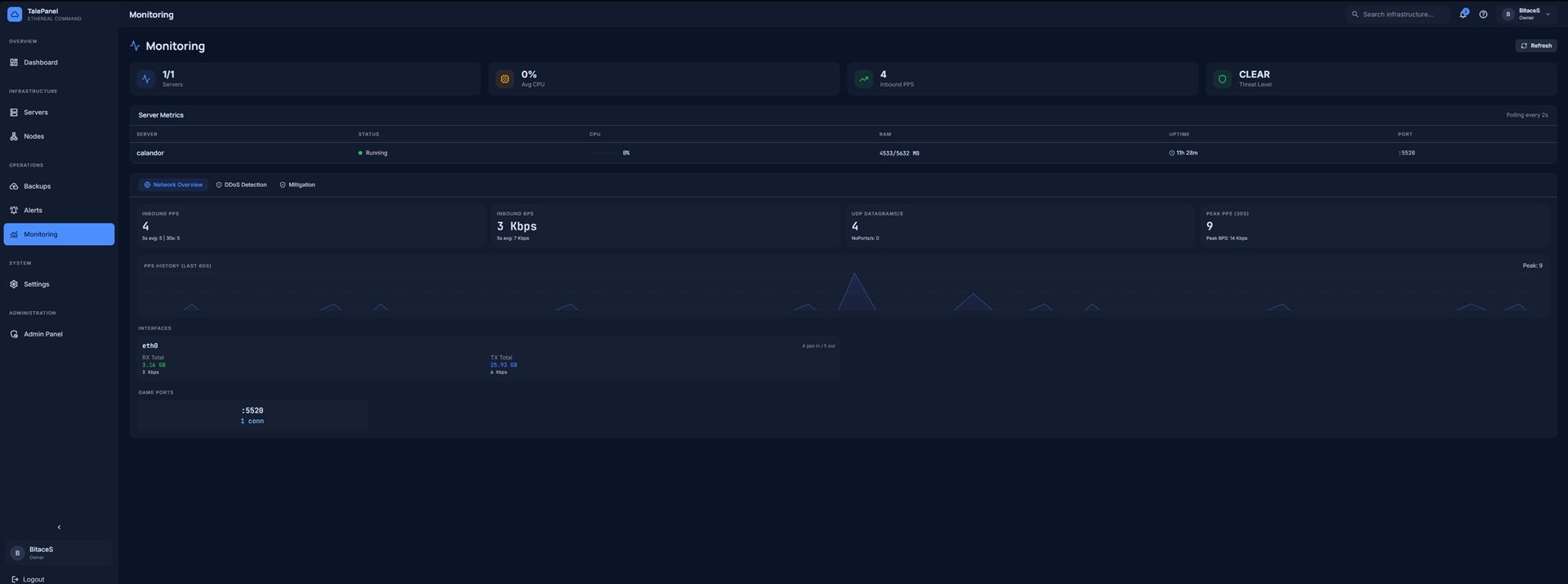
Server migration between nodes is built in: stop the server, pick the target node, the data is transferred and the server record only re-points once the target actually holds it — a failed transfer does not lose data. The daemon also watches the Hytale UDP ports for flood patterns and can rate-limit them with nftables before they reach the game.

Built for a staff team, not one admin

Roles plus 18 granular permission keys, enforced on every route: who may start, who may open the console, who may touch files, who may install mods, who may ban, who may restore a backup, who may see or reset database credentials. Invite people to a single server by token and revoke them again.

TOTP two-factor with the secret encrypted at rest. Active sessions listed and revocable one by one. An audit log across every API action — who did what, when, from which IP, with trusted-proxy handling so the client IP can't be spoofed by a header.

It knows what a Hytale server is

Provisioning runs the official Hytale downloader — or hardlinks from a local hytale-bin directory, so a new server starts in a blink and works on boxes that can't reach the Hytale CDN at all.

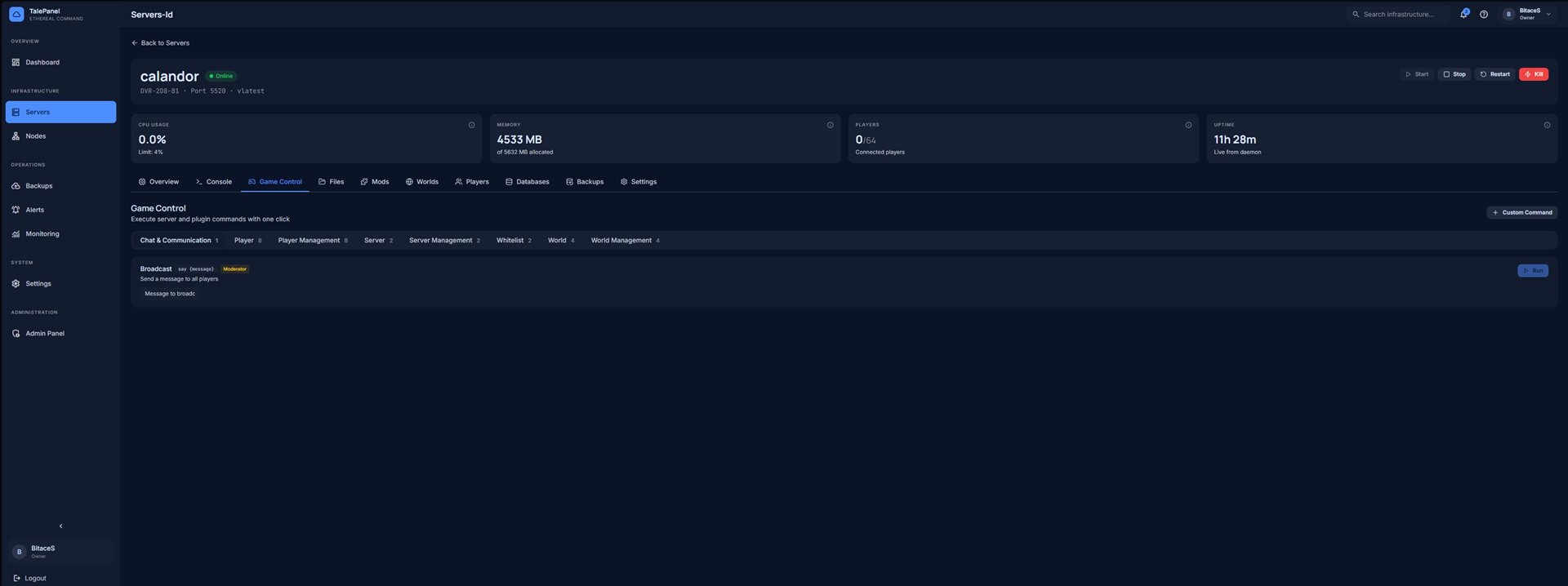
The daemon parses join and leave events out of the real server log into a player registry with sessions and playtime. Moderation uses the actual Hytale command syntax (op, kick, ban, mute, whitelist) from the panel. Mods are detected on disk with SHA256, worlds are detected on the node. A generic panel hands you a container and a file tree; this hands you servers, worlds, mods and players.

The fair comparison

Why not just use a Pterodactyl egg?

If you already run Pelican or Pterodactyl, importing a Hytale egg takes an afternoon and you get multi-node out of it. That is a real answer and we are not going to pretend otherwise. If your Wings cluster is up and your staff workflow works, staying put is a defensible decision.

What an egg cannot give you is Hytale. To a generic panel your worlds are directories, your mods are uploads, your players are lines in a log file, and every moderation action is a command you type into a console yourself. TalePanel models them: a player registry built from the server log, mods with versions and hashes, worlds detected on the node, moderation with the real command syntax. Around that sits the boring infrastructure a network actually needs — file manager with streaming multi-GB uploads, scheduled and manual backups with retention and restore, per-server MariaDB databases, alert rules to email, webhook or Discord. And it installs with one command instead of Docker plus Wings plus an egg import.

So: if you want a mature, generic, battle-worn orchestrator, use Pelican. If you want a panel that understands the game, this is the only one being built.

Known limits — v0.9.0-beta
  • Not production-hardened by anyone but its author. It is beta. Run it on a box you can rebuild.
  • The console, logs and metrics poll — the daemon polls the API for commands every 2s and heartbeats every 10s. There is no WebSocket push. It feels near-live; it isn't a live stream, and calling it one would be a lie.
  • Backups are written to the node's own disk. There is no offsite or S3 target yet — a dead disk takes the backup with it.
  • World management is an overview: worlds detected on the node, set the active world, delete a world. Nothing more.
  • No mod marketplace browser, no mobile app, no desktop app. Web panel, that's it.

Better you read that here than find it on your own box. Roadmap and open issues are public.
Shots of a running instance

Every claim on this page, on screen.

Running one server?

It scales down as well as it scales up.

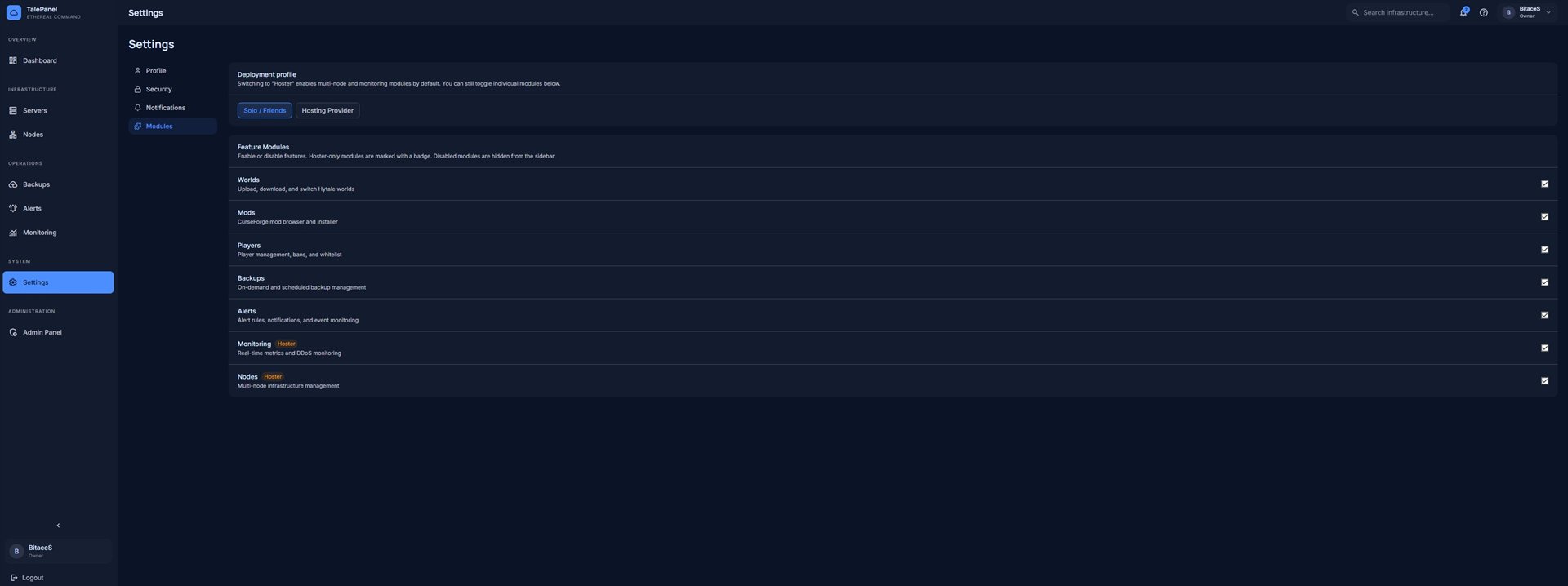
Nothing here forces you into a cluster. Install with --mode both and the control plane and the daemon land on the same machine — one box, one command, done. Then open Settings → Modules and switch off whatever you don't use: Nodes, Monitoring, Alerts, Backups, any of them. The solo preset does it in one click, turning off the two modules that only a hoster needs. No empty "Nodes" tab taunting you with a cluster of one.

What you keep is the whole panel:

  • Console with command execution and persisted logs
  • File manager: browse, edit, upload, download, archive
  • Worlds detected on disk — set the active one, delete one
  • Mods and plugins: upload, enable, disable, remove, switch version
  • Players parsed from the server log, with ban / kick / op / mute / whitelist
  • Backups: manual and scheduled, with retention and restore
  • TOTP two-factor and revocable sessions on your own account
  • Per-server MariaDB database in one click

The point isn't that it tolerates one server. The point is that it's the same product either way. The day your community outgrows the box, you run the same installer on a second machine with an enrollment token, turn Nodes back on, and migrate the server across — no rebuild, no second tool, no panel you should have picked in the first place. Everything else here asks you to choose up front: a small dashboard you'll outgrow, or a cluster orchestrator that's overkill today.

Start on one box. Grow into a cluster. It's the same panel.

Everything in the box

One build. No paid tier, no feature gate.

There is no "enterprise" edition to upsell you later. This list is the whole product, and the licence makes sure it stays that way.

  • Multi-node cluster: Go control plane + Rust daemon, node enrollment with single-use tokens
  • Server migration between nodes: data is transferred first, the record re-points only on success (server must be stopped)
  • Granular RBAC: roles plus 18 permission keys, checked on every route
  • Server invitations: invite, accept and revoke team members per server
  • Audit log across every API action, with trusted-proxy handling so client IPs can't be spoofed
  • TOTP two-factor authentication, secret encrypted in the database
  • Session management: list and revoke active sessions individually
  • File manager: browse, edit, upload (streaming, multi-GB), download, rename, archive, extract
  • Backups: manual and cron-scheduled, with retention, restore and download — stored on the node itself
  • Alert rules with email (SMTP), webhook and Discord notifications
  • Per-node CPU / RAM / disk / network metrics and aggregated cluster stats
  • On-node UDP flood detection with optional nftables rate limiting on the Hytale ports
  • Console with command execution and persisted logs (polled, not pushed)
  • Hytale game-command templates (op, kick, ban, give, tp, gamemode, time set, world save, broadcast)
  • Provisioning via the official Hytale downloader
  • Offline / air-gapped provisioning by hardlink from a local hytale-bin directory
  • Player registry: join/leave parsed from the server log into players, sessions and playtime
  • Player moderation from the panel: ban, unban, kick, op, mute, whitelist
  • World overview: worlds detected on the node, set the active world, delete a world
  • Mod and plugin management: upload, enable, disable, remove, switch version, in both mods/ and plugins/, with on-disk SHA256 detection
  • Per-server MariaDB database in one click, with credentials and password reset
  • Deployment profiles (solo / hoster) that hide or show the multi-node and monitoring modules
  • Hardening: Redis-backed rate limiting, security headers, placeholder-secret detection at boot, no seeded admin account
  • One-line installer with Let's Encrypt, sslip.io fallback, and upgrade / uninstall / check modes
  • AGPL-3.0 — nobody gets to close this and resell it

Put it on a spare VPS in five minutes.

One command. Real certificate. Your owner account. Then run the same script on your second box with a single-use token and watch it enroll itself.

install.sh — panel | daemon | both | upgrade | uninstall | check
sudo bash <(curl -fsSL https://raw.githubusercontent.com/BitaceS/talepanel/main/scripts/install.sh)